

Few Christian movements were born in such an unlikely way as Calvary Chapel. There was no growth plan, nor an elaborate expansion strategy born out of a church-planting network training. There was a small, almost forgotten congregation in a California trailer park, a middle-aged pastor tired of denominational legalism, and a generation of young hippies that no one else in the American church knew how to reach.
From there was born one of the most influential evangelical movements of the 20th century, today present in thousands of churches around the world. But what exactly is Calvary Chapel? Where did it come from? Who founded it? And how many churches does it have today? This article answers these questions and provides a timeline of the events that marked the history of the movement, from the early 1960s to today.
What is Calvary Chapel?
Calvary Chapel is not a denomination in the traditional sense, although many believe we are, and that is completely understandable. There is no central headquarters that issues rules, nor a bishop who appoints pastors. It is, practically speaking, a family of independent churches that share the same core convictions: the expository teaching of the entire Bible (book by book, verse by verse), practical dependence on the Holy Spirit, a culture of grace, the commitment to reach every generation, the expectation of Christ's return, and a leadership model based on servanthood rather than status.
Each Calvary Chapel church is autonomous, governed by its own senior pastor and leadership board, yet all recognize themselves as part of the same spiritual family, bound by conviction rather than hierarchy. This balance between local freedom and shared identity is at the heart of everything that happened afterward.
Where did Calvary Chapel come from?
Contrary to what many think, the congregation called "Calvary Chapel" already existed before the name became synonymous with a worldwide movement. It was born in the spring of 1961, in the recreation room of a trailer park on Newport Boulevard in Costa Mesa, California, when a group of elderly ladies asked Pastor Floyd Nelson to lead a small interdenominational congregation. The church was formally incorporated in December of that year, and the following year, it purchased a small building on Church Street.
It was only in October 1965 that Pastor Floyd Nelson invited a 38-year-old preacher named Chuck Smith to preach at that small church, at the time, with only 25 members. Smith was elected associate pastor on November 18, 1965, and took over as senior pastor in September 1966. It is from this moment that the history of Calvary Chapel, as we know it today, truly begins.
Who was the founder of Calvary Chapel?
Technically, the congregation already existed before Chuck Smith arrived. But he is universally recognized as the father of the Calvary Chapel movement, the man whose conviction to teach the Bible verse by verse, chapter by chapter, book by book, would become the hallmark of thousands of churches around the world.
Charles Ward "Chuck" Smith was born on June 25, 1927, in Ventura, California. He graduated from Life Bible College and was ordained as a pastor by the International Church of the Foursquare Gospel, a denomination in which he served for years before leaving its ranks, tired of the legalistic structures he saw there. Alongside his wife, Kay Smith, he arrived in Costa Mesa in December 1965 to pastor a small church, without imagining that, decades later, he would have trained hundreds of pastors and seen the birth of more than a thousand churches in the United States alone. Chuck Smith passed away on October 3, 2013, at age 86, a few days after preaching his final sermon.
The Jesus Movement: When a Small Church Became a Revival
The year 1967 was the turning point. That summer, Chuck and Kay Smith began opening the church doors to the hippies who crowded the beaches of Southern California: barefoot, long-haired youths, many of them coming straight from the drug culture and counterculture. In 1968, Smith invited the young Pentecostal evangelist Lonnie Frisbee to lead Bible studies aimed at this audience. Frisbee brought a charismatic and direct style that, combined with Smith's systematic biblical teaching, sparked an explosive response: in a few weeks, dozens of conversions; in a few years, thousands.
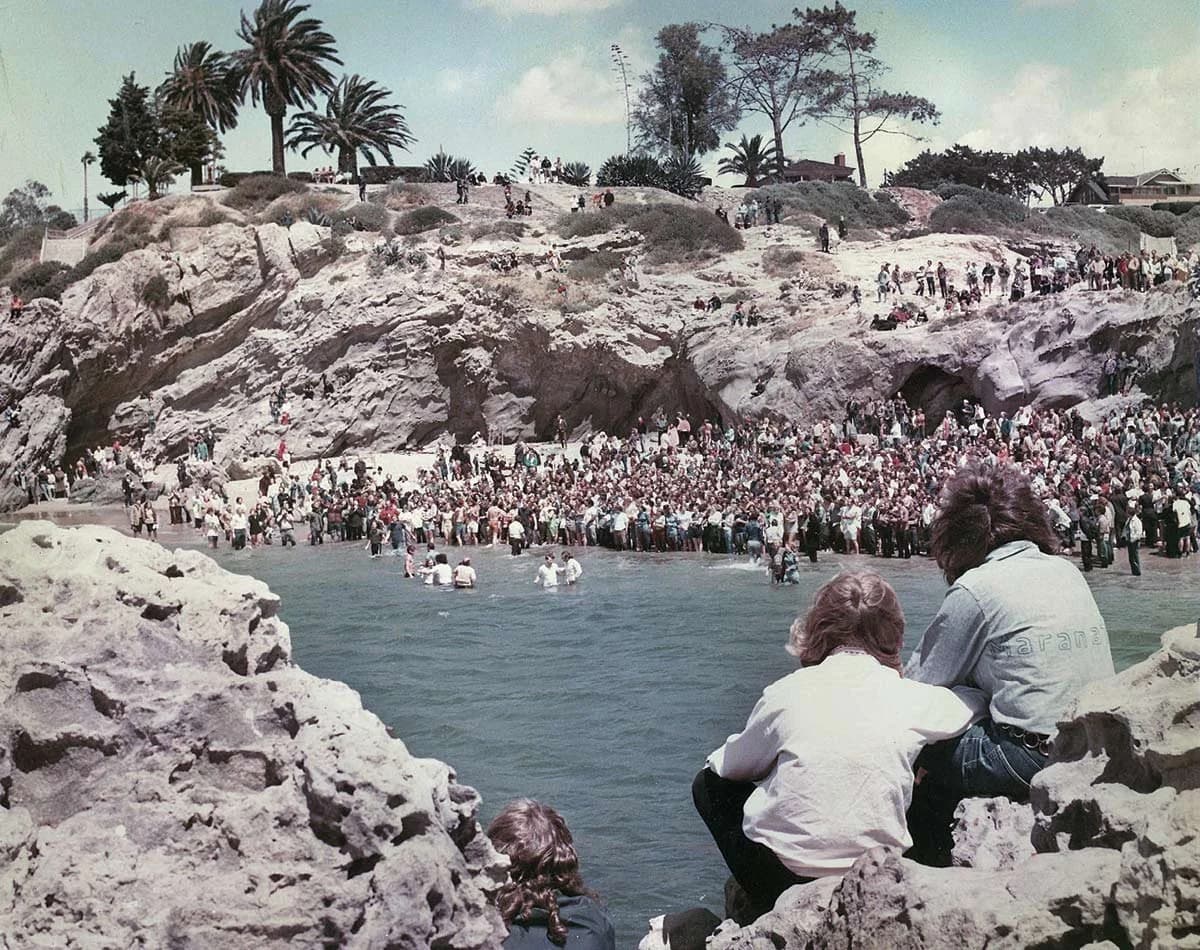
Baptisms took place in the Pacific Ocean at Pirate's Cove in Corona del Mar, sometimes 500 people all at once. The small congregation of 25 people in 1965 grew to over 2,000 in the early 1970s, forcing the church to move into a circus tent.
This phenomenon, dubbed the "Jesus People Movement," spread throughout North America, Europe, and Oceania, and is portrayed in the book by Chuck Smith and Hugh Steven, The Reproducers: New Life for Thousands (1972), and, decades later, in the film Jesus Revolution (2023), starring Kelsey Grammer as Smith.
It was also from this effervescence that a new sound was born in the church: in 1971, Calvary Chapel gave rise to the Maranatha! Music label, created to promote the spiritual "folk-rock" that bands like Love Song and Children of the Day played in services, one of the cradles of contemporary Christian music as we know it today.
If because of dirty jeans we have to say to a young person, "I'm sorry, but you can't come to church tonight, your jeans are too dirty," then I am in favor of getting rid of the padded pews. Let's buy plain benches or chairs, or anything else we can wash. But we will never close our doors to someone just because of the way they dress or look.
Chuck Smith, founder of Calvary Chapel
Timeline: Some of the Key Milestones of Calvary Chapel
1960s
1965: Calvary Chapel Costa Mesa, California. The "Jesus Movement" begins along with the emphasis on the expository teaching of the Word.
1970s
Accelerated growth: over 8,000 baptisms in two years. In 1973, inauguration of the tent, with three Sunday services and over 4,000 people in each of them.
1980s
1987: Calvary is on the radio, television, on tapes and recordings. Major investment in missions.
1990s and 2000s
These were golden years, quite differently from the years of revival: years of many young people trained in Bible Colleges and Schools of Ministry, and of sending many people to plant churches in various parts of the world. It even had its beginning in São Vicente, the first city in Brazil, in 2001, kicking off the church movement in Brazil.
Today
2026: approximately 1,500 communities around the world. One of the top 10 Protestant churches in the USA, now with at least three networks: CCA, CGN, CCC, and other expressions of Calvary Chapel.
One Fire, Many Churches
If there is one word that sums up the history of Calvary Chapel, it is perhaps simplicity: a pastor determined to let the Bible speak for itself, and an entire generation that, despite all cultural distance, found in it exactly what they were looking for.
More than sixty years after that small congregation in a trailer park, the movement today discusses succession, structure, networks, and numbers. But the heart remains the same as described by Chuck Smith himself:
If I didn't plan or seek to control the ministry while I am alive, why would I try to plan and control it after I'm dead?
A question that continues to shape thousands of churches around the world, each one free, and all bound by the same fire.
You know what a beautiful thing about the name Calvary is? People don't really know what your views are. Put Baptist in your name and people know where you stand, and half the people will never come because it's a Baptist church. Put Presbyterian in your name and people know where you stand, and half of them will never come because they know what Presbyterians believe. Put Foursquare in your name and you're stereotyped immediately. People already know who you are and they don't need to come. But "Calvary" has a bit of mystery to it: "What do these people believe? I don't know, but let's find out."
Chuck Smith, founder of Calvary Chapel
Calvary Chapel began as a move of God, an outpouring of grace, renewal, and mission that no one could have planned or contained. It was the fruit of God's work through ordinary people who simply loved Jesus, trusted in His Word, and followed the guidance of His Spirit.
This series of articles was born from the desire to visit our roots and our history, to have a reference for the current generation and for future generations, and thus to be inspired for the future.